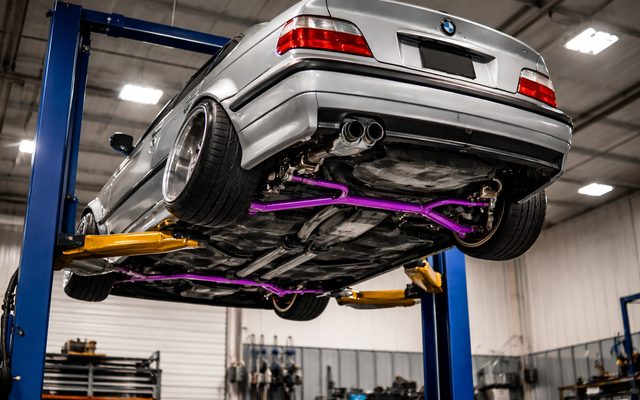
In the high-stakes realm of modern professional oversteer competition, success is not merely exclusively a function of raw torque or driver aggression. Conversely, it is now a intricate discipline which requires a meticulous fusion of choosing a inherently capable car, outfitting it with the highest-quality competition hardware, and, most importantly, comprehending its real-time characteristics on the course through sophisticated suspension tuning applications. This definitive handbook functions as your blueprint starting from the very first concept of a drift build all the way to the final engineering-refined refinements that turn a powerful car into a consistent podium finisher. We will thoroughly explore the art and science of car suspension tuning, showing how a state-of-the-art suspension tuning tool like GripDial removes approximation and delivers unmatched visibility into your vehicle's real-world performance.
The bedrock of any successful competitive sliding vehicle is, undoubtedly, the chassis itself. Several cars have earned legendary standing within the worldwide drifting scene due to their inherent balance, strong build quality, and the enormous availability of specialist components available. Choosing the right car is the initial and most important decision a builder will make. For instance, the BMW E36 is commonly accepted as one of the greatest all-around cars for drifting of history. Its excellent evenly distributed mass, combined with a driven rear axle layout and extremely reliable six-cylinder motors, establishes a car that is both easy to handle for novices and highly effective in the possession of a professional driver. The evolution of this philosophy, the BMW E46, builds upon these strengths with a even more sophisticated chassis, increased wheel track for improved stability, and yet a greater degree of steering angle directly from the factory. A different dominant option in the pro scene is the Chevrolet Corvette C6.
This American sports car offers a distinctive set of benefits to the sideways sport, such as a low-mass aluminum structure, a rear-mounted transaxle that aids in an excellent balance, and the tremendous thrust of a powerful LS V8 motor. This combination makes it an utter monster on track, capable of starting and maintaining continuous angles with relatively effortless application of throttle. For drivers desiring outstanding value, the Nissan Z33 excels as a excellent choice. It arrives from the factory with a stiff body structure, a effective OEM locking differential, and the free-revving VQ35DE engine that offers plenty of power and torque for learning and advancing in the activity. Its successor, the Nissan 370Z, brings further improvements in chassis stiffness, steering geometry, and overall motor power, solidifying its place as a common pick among competitive competitors. Other iconic cars that warrant attention encompass the agile rotary-powered Mazda FC, the ever-present Nissan S13 240SX, the American Ford SN95, the electronic-equipped E90 3 Series, and the compact yet unbelievably fun and teachable MX-5 Miata. All of these chassis offers a unique palette of traits, difficulties, and possibilities, but they all have in common the basic ingredients essential to become a competitive drift car.
However, picking the correct car is merely the starting point. To access the complete capability of every of these machines, significant changes to the steering system and chassis control systems are utterly mandatory. This is where the world of precision tuning components comes into vital focus. The single most game-changing modification for a serious drift machine is the installation of a maximum-angle angle modification kit. These engineered systems, like those developed by industry leaders like SLR, are engineered to radically increase the chassis's possible lock-to-lock rotation. A factory street car is highly constrained in how far its steering tires can rotate, a design trade-off for on-road driving. In drifting, conversely, extreme opposite lock is constantly necessary to control and hold a angle. An angle kit replaces the factory steering knuckles, tie rods, and often A-arms with pieces that enable the front tires to attain angles in excess of 70 or even 80 °, versus a typical stock angle of around 40 to 50 degs.
This vastly greater steering angle offers the driver with dramatically enhanced control during a angle, making it considerably simpler to start a drift, sustain it through a sweeping corner, and switch fluidly from one side to another. The difference in drivability is nothing short of transformative. Coupled with a properly chosen steering kit is the just as critical enhancement to the chassis's suspension. Store-bought or even premium sport adjustable suspension are generally not intended for the specific and brutal demands of competitive oversteer. A drift-spec pair of adjustable dampers is paramount. These engineered suspension components incorporate unique damping rates and spring stiffness that are optimized for the violent weight transfer that is typical of sliding. When a driver initiates a drift, the chassis's inertia is transferred violently to the outside of the turn. Optimal competition suspension handle this movement in a controllable way, allowing the chassis to stabilize quickly and offering the pilot precise feel through the wheel and seat. They also allow for precise tuning of stance, rebound and compression firmness, and weight balance, which are all key elements of dialing in the vehicle's dynamics to a particular track or driving technique. Together, a top-tier angle modification system and a properly specified system of performance adjustable dampers constitute the core physical cornerstone upon which all future refinement is constructed.
Once the core parts is in place, the subsequent critical phase in the development is the detailed setting of the vehicle's alignment. This is the world of vehicle alignment optimization, a methodology that can feel intimidating to the uninitiated but is, in fact, the defining factor to converting a assembly of fast pieces into a harmonious and consistent machine. The most debated aspect of alignment for sliding is definitely negative camber. Camber angle is the angle of the wheel relative to the vertical line when looked at from the front-on of the vehicle. If the upper part of the wheel is tilted towards the car, this is referred to as negative camber. In sliding, an inward tilt on the steering wheels is universally used and is seen as critical. The purpose is intrinsically related to vehicle dynamics.
When a chassis is turning at high sideways angles, the frame rolls toward the outer of the corner. This body roll makes the outside front wheel to reduce its best contact patch with the asphalt. By introducing an inward tilt, the tire is pre-leaned to counteract this tilt. As the car rolls into the bend, the outside front tire becomes more upright against the track, increasing its traction at the exact moment when it is needed most for steering authority. Typically, front adjustments for a serious drift machine fall between approximately -3 degrees to as much as -5 degrees or even beyond, depending on the specifics of the car configuration, tire type, and pilot style. The rear tires also employ inward lean, but the settings are usually less and less aggressive than the front. Overly aggressive camber at the back can make the car overly prone to oversteer and challenging to control on power application, as it diminishes the available tire footprint of the powered wheels during linear throttle application. Therefore, rear axle adjustments are frequently in the vicinity of -1 degree to -3 degrees, striking a precise balance between providing enough lateral traction to assist in starting and sustaining the angle while simultaneously preserving good grip for exiting the corner. camber angle is merely one element of the more complex tuning puzzle, which additionally includes toe setting, caster angle, and steer correction adjustment.
Toe angle is the orientation of the tires when viewed from above. Inward toe means the leading edges of the wheels are nearer together than the trailing edges, while toe-out means the converse. For oversteer, a slight amount of front negative toe is frequently employed to improve the turn-in handling reaction, making the chassis feel more agile and eager to begin a oversteer moment. Rear axle toe is generally set to neutral or a incredibly slight amount of toe-in to promote predictability under throttle. Caster is the forward or aft angle of the suspension pivot when viewed from the side-on of the car. More caster angle increases self-centering and high-velocity confidence, and it also boosts negative camber gain during steering, which is extremely beneficial. Adjusting these settings is a complex interplay where a modification to one parameter can and will affect the other settings. The conventional method for dialing in a vehicle's alignment for competition has long been a labor-intensive affair of guesswork and adjustment. A pilot or team would introduce a modification based on intuition, run the chassis on track, depend on the pilot's personal feel and comments, and then make a further tweak. This loop would repeat again and again until the chassis felt "right" or the allotted track time was exhausted. This system is not just incredibly inefficient in terms of man-hours and resources, but it is furthermore inherently inaccurate.
Human perception is a infamously unreliable metric, affected by numerous variables such as fatigue, evolving track surfaces, ambient heat, and just the focus of the pilot on that given session. What feels "oversteery" on one lap might feel "understeery" on the subsequent lap, resulting in confusing data and ineffective tweaks. This long-standing problem in vehicle dynamics optimization is exactly where modern technology has made its mark to transform the landscape.
The development and adoption of sophisticated vehicle dynamics tools has brought about a radically different age for engineering and perfecting competitive drift machines. This new generation of systems, represented by cutting-edge solutions like GripDial, work by directly capturing the real-time physical performance of the chassis as it is operated on the course. In contrast to using driver feel, these devices gather quantifiable metrics on essential variables such as damper compression and extension, individual tire rotation, lateral and longitudinal g-forces, lock position, and driver input position. This collected telemetry is then interpreted by powerful algorithms that can visualize and interpret the information in a comprehensible format. For the first time, drivers and builders can observe specifically what the chassis is exhibiting at any given moment of a drift. This function transforms the entire alignment optimization procedure. Think about the specific goal of optimizing the front axle camber for a specific car. Rather than introducing a adjustment from -3 degrees to -3.5 degrees and then driving multiple runs to try and "feel" a change, a vehicle dynamics tool can give instant and definitive feedback. The tool can indicate graphically how the suspension's grip is behaving during the critical stages of a drift: the initial flick, sustain, and changing direction. It can show if the current angle is permitting the loaded tire to maintain ideal contact or if the compound is over-stressed on its outer edge.
The software can subsequently provide fact-based suggestions for modification. Perhaps the telemetry reveals that the tire is still overworking its outer shoulder at -3.5 degrees of negative camber, suggesting that a move towards inward lean, say -4 degrees, might be beneficial. On the other hand, the data might indicate that the tire is not reaching optimal operating temp or that the inside shoulder is wearing unevenly, which vehicle dynamics tool could point to that there is excessive angle and a modest reduction back to -3.2 degrees would be more efficient. This standard of accuracy and useful insight was simply impossible in the days of solely manual tuning.
The effect of employing a advanced vehicle dynamics tool extends far beyond only optimizing alignment. It functions as an priceless suspension tuning guide that is tailored to your exact car. When fine-tuning the damping values on your coilovers, rather than using vague tips or copying another team's numbers, you can employ the telemetry to see how the car is performing in relation to your tweaks. The application can show the suspension travel trace over a lap, showing if the coilovers are controlling the body movement properly or if they are allowing the vehicle to oscillate uncontrollably after a transition. It can aid in identifying problems like excessive compression or excessive extension, enabling you to apply educated decisions to spring preload, damping values, or ride height. This approach extends just as well to the complex process of car alignment tuning. In addition to camber, the system can give data into how adjustments to toe and caster are affecting the chassis's balance during different parts of a drift. For instance, it can assist you to find the ideal amount of front axle toe-out for your individual steering configuration and driving technique by measuring the response time of turn-in reaction and the predictability of the chassis at maximum steering angle. This transforms the system an incredibly powerful performance optimization handbook that is dynamically calibrated by the actual behavior of your personal vehicle on the circuit. It moves the entire project from a dark art into a methodical engineering procedure.
Additionally, the application of a tool like data acquisition is not at all restricted to experienced teams with extensive resources. For the amateur enthusiast, it acts as an amazing equalizer. It in essence offers the driver with the analysis of a full-time coilover setup tips dynamics engineer without the typical expense. It accelerates the tuning process by giving clear directions to questions that would normally take years of experience to solve. A driver can understand how their specific car behaves to different settings, building a more profound knowledge of suspension theory in the process. It additionally makes accessible drift suspension tuning guide professional suspension engineering principles, permitting all drivers with the drive to refine their car to do so in a efficient and effective manner. This is particularly important in a sport like sliding, where tuning know-how has traditionally been a tightly held advantage among elite drivers. Today, that knowledge can be in the hands of every serious driver.
In conclusion, the path to building and tuning the ultimate championship-contending drift machine is a comprehensive mission that smoothly combines time-honored hardware principles with cutting-edge telemetry technology. It begins with the strategic pick of a proven car, then enhanced by the installation of non-negotiable performance parts like high-performance steering angle kits and correctly selected drift-spec suspension units. The journey then moves into the detailed realm of chassis dynamics adjustment, where parameters like camber, toe setting, and caster are carefully set to suit the car's new capabilities and the driver's individual style. Ultimately, and what genuinely differentiates the modern approach from the past, is the integration of a powerful drift telemetry software. This system removes the approximation and trial and error of only subjective adjustment by delivering objective, real-time telemetry on how the chassis is truly behaving. It acts as an incredible suspension tuning tool, a definitive drift suspension tuning guide, and a all-in-one chassis development system. As a complete package, this complete philosophy ensures that every aspect of the competition vehicle—from the pick of the chassis to the most minute tweak on the coilover—is optimized for ultimate performance on the circuit. It signifies the full maturation of the art of oversteer driving, merging physical car control with surgical suspension engineering to build the most effective cars possible.